Sep 3, 2026CNC Machining Guides
How to Choose a Reliable Precision CNC Machining Supplier for Critical Industrial Components
Selecting the right precision CNC machining supplier is essential for OEM companies requiring high-quality, reliable, and consistent components.
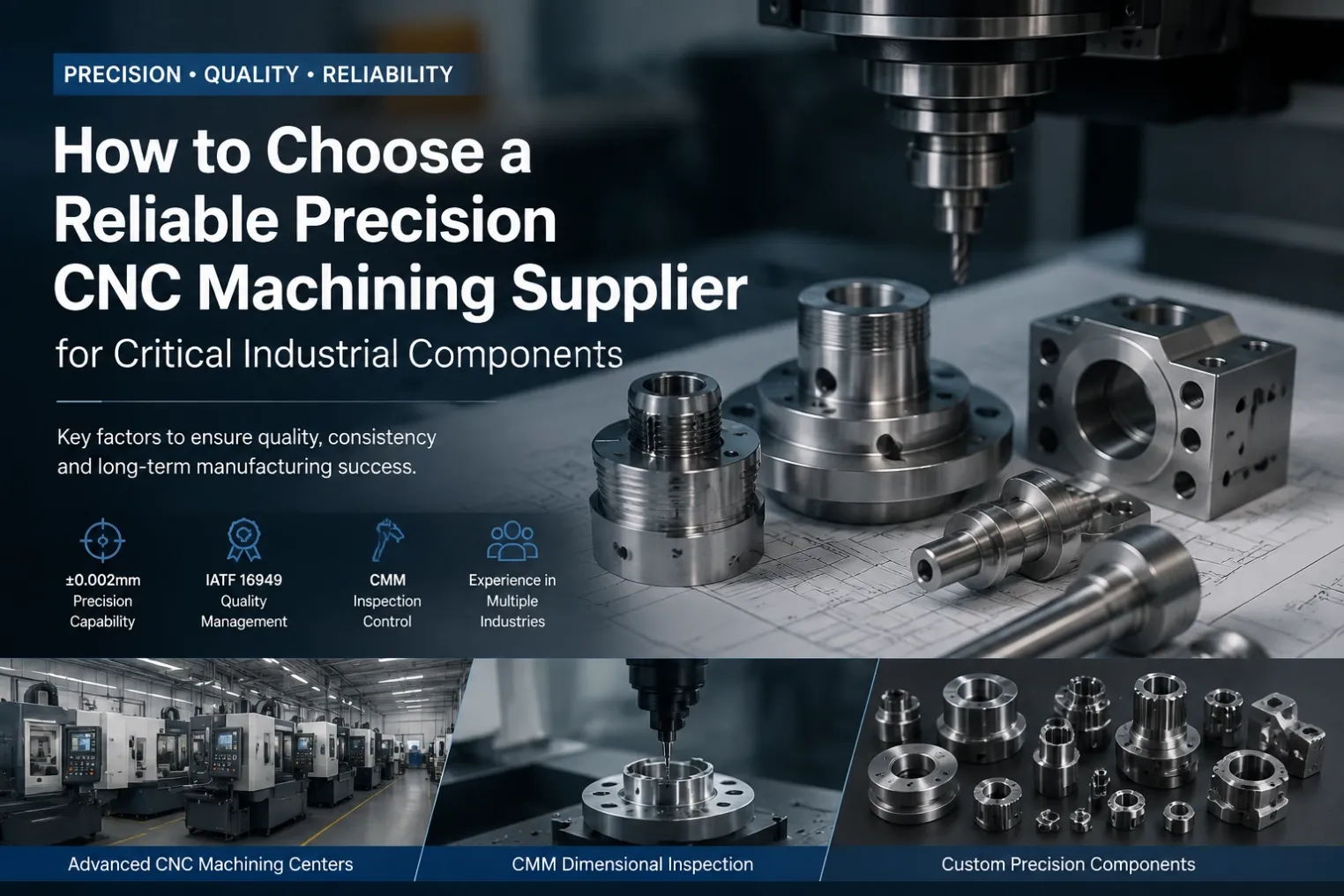
Choosing a precision CNC machining supplier involves more than comparing prices. For custom parts, a supplier must understand your drawings, control critical dimensions, document inspection results, and communicate clearly throughout production.
This guide explains what engineers and procurement teams should check when selecting a CNC machining partner for prototypes, small batches, and repeat production.
1. Define Your Part Requirements Before Comparing Suppliers
A useful quotation starts with clear technical information. Without it, different suppliers may quote different materials, processes, tolerances, or inspection scopes.
Prepare the following information before requesting a quote:
- A revision-controlled 2D drawing and, where available, a 3D CAD model.
- Material grade and any heat-treatment requirements.
- Prototype quantity, production quantity, and expected repeat demand.
- Critical dimensions, tolerances, fits, and datum references.
- Surface-finish, coating, and cosmetic requirements.
- Inspection reports or material documentation required.
- Expected delivery date and shipping destination.
Identify which features affect assembly, sealing, movement, or product performance. This helps a supplier focus its manufacturing review on the requirements that matter most.
2. Match the Supplier’s Capabilities to Your Part
Do not evaluate machining capability only by machine quantity or a headline tolerance. Ask whether the supplier can manufacture your specific geometry, material, and critical features.
For CNC milling, discuss:
- Pockets, slots, holes, thin walls, and complex profiles.
- Tool access and the number of setups required.
- Flatness, positional tolerances, and relationships between features.
- Part size and workholding requirements.
- Whether multi-axis machining is necessary for the design.
For CNC turning, discuss:
- Shafts, bushings, sleeves, pins, and threaded components.
- Concentric features and runout requirements.
- Internal bores, grooves, and surface-finish requirements.
- Slender sections that may need additional support.
- Milled features that could benefit from a turn-mill process.
A useful supplier response explains the proposed process and its limitations. A general claim of “high precision” is not a substitute for a drawing-specific review.
3. Ask How Critical Features Will Be Inspected
A supplier should be able to explain how it will verify the requirements on your drawing.
Useful questions include:
- Which dimensions will be checked during first-article inspection?
- How will critical features be monitored during production?
- What measuring equipment is suitable for the specified tolerances?
- How will threads, surface roughness, runout, or geometric tolerances be verified?
- What inspection records will accompany the shipment?
- How are measuring instruments calibrated and maintained?
A coordinate measuring machine, or CMM, can be useful for complex dimensional inspection. However, the appropriate inspection method depends on the feature and its requirements. Some features require gauges, micrometers, surface-roughness instruments, or other measurement methods.
Agree on the inspection scope before placing the order, especially when detailed reports or customer-specific documentation are required.
4. Review Quality Certifications and Their Scope
Quality certifications can support supplier evaluation, but they should be reviewed alongside actual manufacturing and inspection practices.
Ask for current certificates and check:
- The certified company name.
- The manufacturing location covered.
- The scope of certification.
- The certificate validity period.
- Whether the scope is relevant to the work you plan to order.
ISO 9001 and IATF 16949 relate to quality management systems. They do not, by themselves, guarantee that an individual component will meet every requirement on your drawing.
Also ask how the supplier manages nonconforming parts, corrective actions, drawing revisions, and material traceability.
5. Confirm Experience with Your Material and Surface Treatment
Material grade, material condition, and surface treatment can affect machining strategy, inspection, cost, and delivery time.
Ask whether the supplier has experience with the material specified for your project. Where possible, review relevant examples with similar geometry or technical requirements.
For coated or heat-treated parts, clarify:
- Whether dimensions apply before or after treatment.
- Which surfaces require masking or protection.
- Whether coating thickness affects threads or mating features.
- Which post-treatment inspections are required.
- How external processing is coordinated and documented.
Avoid accepting a material substitution or process change without understanding its effect on the component’s application.
6. Evaluate Engineering Communication
Good engineering communication helps resolve unclear requirements before they become production problems.
A supplier should raise questions when drawings contain conflicting dimensions, missing tolerances, inaccessible features, or uncertain surface-treatment requirements.
Useful design-for-manufacturing feedback may address:
- Features that require additional setups.
- Deep pockets or difficult tool access.
- Thin walls and slender sections.
- Unnecessarily tight tolerances on noncritical features.
- Opportunities to simplify inspection or machining.
Any proposed design, material, or tolerance change should be submitted for your approval before implementation.
Look for clear questions and documented decisions—not automatic promises that every requirement is easy to achieve.
7. Compare Quotations on the Same Basis
The lowest unit price does not necessarily represent the lowest total project cost.
When comparing quotations, check whether each offer includes the same:
- Material grade and condition.
- Quantity and batch size.
- Machining and secondary operations.
- Surface treatment.
- Inspection scope and documentation.
- Tooling or setup charges.
- Packaging and shipping terms.
- Delivery assumptions.
Clarify whether the quoted lead time starts after order placement, drawing approval, material arrival, or another milestone.
A quotation should make its assumptions clear so that you can compare suppliers fairly.
8. Use a Trial Order to Evaluate Performance
For a new supplier, a prototype or small trial order can provide useful evidence before committing to larger production volumes.
Evaluate more than the appearance of the delivered parts. Check:
- Conformance to the agreed drawing revision.
- Critical dimensions and inspection records.
- Fit and function in the intended assembly.
- Surface condition, deburring, and cleanliness.
- Packaging and protection during transport.
- Delivery performance and communication.
- How questions or nonconformities are handled.
Record the results and resolve any issues before approving repeat production.
9. Check Readiness for Repeat Production
A successful prototype is an important starting point, but repeat orders also require consistent processes and clear change control.
Discuss how the supplier manages:
- Approved drawings and revision changes.
- Material identification and traceability.
- Repeat setups and inspection requirements.
- Production scheduling.
- Changes to tooling or manufacturing processes.
- Nonconforming parts and corrective actions.
For ongoing projects, agree on how changes will be communicated and when renewed sample approval or inspection is required.
A Practical Supplier-Selection Checklist
Before placing an order, confirm that you can answer these questions:
- Has the supplier reviewed the current drawing revision?
- Are material, tolerances, and surface treatments clearly agreed?
- Is the manufacturing approach suitable for the component?
- Are critical features linked to an appropriate inspection method?
- Have certification scope and validity been checked?
- Does the quotation clearly state what is included?
- Are delivery assumptions and responsibilities understood?
- Is there a process for approving changes and handling quality issues?
- Have confidentiality requirements been agreed?
- Is a trial order appropriate before larger-scale production?
Working with Zync Precision
Zync Precision provides custom CNC milling and turning services for components manufactured to customer drawings. Our factory holds ISO 9001 and IATF 16949 quality management system certifications.
When discussing a new project, we review the part geometry, material, quantity, critical tolerances, surface requirements, and inspection needs to assess a suitable manufacturing approach.
Specific capabilities, documentation, pricing, and lead time should be confirmed during project review.
Frequently Asked Questions
What should I send when requesting a CNC machining quote?
Send your 2D drawing, available 3D CAD file, material grade, quantity, tolerances, surface-treatment requirements, inspection needs, and expected delivery date. Include the drawing revision and highlight any critical features.
How do I compare CNC machining suppliers fairly?
Provide the same technical information to each supplier. Compare material, process scope, inspection, documentation, delivery assumptions, and shipping terms—not just the unit price.
Does a tighter tolerance always mean a better part?
No. Tolerances should reflect the component’s function and assembly requirements. Unnecessary precision can add machining and inspection work without improving performance. Any tolerance change should be approved by the design owner.
Should I choose CNC milling or CNC turning?
Turning is commonly used for cylindrical features, while milling is used for features such as pockets, flats, and complex profiles. Some components require both. The appropriate process depends on the drawing and production requirements.
Is certification enough to approve a supplier?
Certification is one part of supplier evaluation. Also review relevant experience, inspection methods, communication, sample results, and the ability to meet your specific requirements.
How can I protect confidential drawings?
Agree on confidentiality requirements before sharing sensitive project information. If an NDA is required, arrange it before sending the drawings and confirm who may access the files.
Request a Review of Your Custom CNC Parts
Looking for a machining partner for your next project?
Send your drawings, material requirements, quantity, critical tolerances, surface finish, and inspection needs to emily@zyncprecision.com.
You can also contact Zync Precision about your project. We will review the requirements and discuss suitable manufacturing options.